

Emerald Gemstone

The emerald is the gem or romance and of royalty. It is the rarest gemstone and, aside from the diamond, the most valuable. Their deep green color sets emeralds apart from all other gems. Emeralds are composed of the mineral beryl and their green color comes from tiny amounts of vanadium and chromium. Emeralds have many inclusions which make every gem unique but also soften the stone. On the Mohs scale for gem hardness emeralds are 7.5 versus 10 for a diamond. Not only are emeralds subject to damage during everyday life, they can easily chip or fracture when being cut or when being set. High pressure and great heat can also damage these gems. The value of the emerald goes up with fewer imperfections and as the color approaches a deep and vivid green.
Emerald Shape
The most popular shapes for an emerald are round, octagon, and cushion. An emerald with fewer inclusions will refract light within the gem before it exits. This improves its sparkle. For such emeralds, a round shape and brilliant cut improve their sparkle. However, color is always the most important attribute of an emerald. Other shapes that help show off an emeralds color are oval, pear, marquise, and princess. These “fancy” shapes are less complex, less difficult to cut, and less expensive than round shapes and cuts. Cushion shapes are commonly about 6 mm or 1.0 carat. Princess shapes are often cut to 5 mm size. Pear and oval shapes can come in all sizes. Some people prefer an emerald instead of a diamond for an engagement ring. This does not always result in a lower cost as high-quality emeralds can be very expensive.
The Size of the Emerald
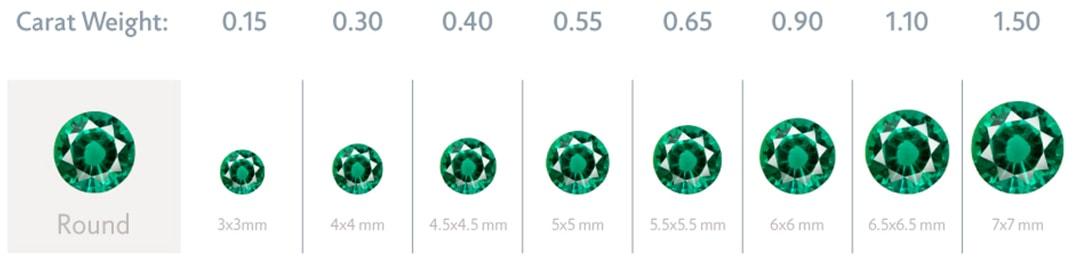
Emeralds are not measured in millimeters and not carats. And as size is added to an emerald the price multiplies. Emeralds are cut deep or shallow by the cutter to show off the gem’s color. A shallow cut can reduce the weight of the gem significantly even though it looks large. Octagon and round shapes appear the largest. Princess and cushion shapes look smaller. A square shape will result in more depth and therefore a greater weight. Emeralds are not cut to avoid inclusions, unlike diamonds. Emeralds always have inclusions which make each one unique. But, fewer inclusions, along with a deeper color result in a more valuable emerald.
Emerald Color
Far and away the most important quality of the emerald is color. When emeralds are graded there are three aspects of color that are important. These are hue, tone, and saturation.
Hue
The ideal hue of an emerald is an exact green in the spectrum of colors. Suggestions of brown, yellow, or blue reduce the quality and value of the gem.
Tone
The best tone for an emerald is a deep and vivid green. To the extent that an emerald’s tone is lighter or very dark, it will detract from the value and reduce the gem’s price.
Saturation
A lower quality emerald may have areas of perfect, deep, rich green. And it may have areas where to hue is more of a blue or yellow. Or it may have a lighter green mixed in. This is a problem with saturation. The best saturation grade is when the deep and rich green is uniform throughout the emerald.
When the emerald is evaluated, it is placed face up over a white surface. Magnification is not required. The gem is rotated back and forth in order to observe the color aspects from all angles. When hue, tone, and saturation are ideal, the quality of the emerald is AAA. Problems in any aspect of color will reduce the quality to as low as a C grade which is the lowest.
The best looking emeralds are a deep and vivid green. And emeralds that have a hint of yellow can also be very attractive. When the emerald has hints of blue or brown they typically are not as attractive and we do not recommend them.
Emerald Clarity
All emeralds have imperfections which are called inclusions. In fact, the emerald ranks among the gems with the most inclusions. Inclusion types which can be seen without magnification include crystals, clouds, needles, pinpoints, feathers, and cavities. These imperfections are the result of uneven crystallization when the gem was formed under intense heat and pressure deep within the earth. Emeralds are not graded or ranked for clarity. Because a lot of inclusions will affect the color grade of an emerald, that is where clarity has its effect.
When inclusions are very large they are easily visible and reduce the color grade as well, resulting in a much lower quality gem. Such inclusion-heavy gems appear washed out.
Clarity of the emerald is examined without magnification with the gem face up. Do not focus on individual inclusions, unless they are huge. Rather view clarity in total with color and color saturation in mind. Common inclusions like little fractures and fissures have a wavy appearance and do not really hurt the appearance of the emerald. When inclusions appear as white wavy lines inside the diamond they are beginning to be problems.
Sourcing Emeralds
The best sources of high-quality emeralds are mines in Colombia, Brazil, and Namibia. Because emeralds are one of the softer gems, emerald mining is mostly done by hand. Machinery and high tech used to mind harder gems like the diamond tend to fracture the emeralds.
Emeralds are found attached to other rock formations, so they are typically not just the only gem being mined. Most emerald mining is from open pits where larger rock formations have been blasted loose. Miners pick through the blasted rock to remove the emerald (natural beryl) and send it to manufacturing operations.
Our emeralds are almost always from the three main suppliers of high-quality emeralds, Colombia, Brazil, and Namibia. We choose these regions for emeralds because their emeralds are vividly green and have fewer inclusions than those from other sources. The uniform quality of these emeralds is such that the mine of origin of an emerald can be known simply by looking at the color! As with other gemstones, we know the mining operations and manufacturers and work directly with them. We choose whom we work with because of the high-quality of their emeralds but also because these operators’ environmental practices are safe and they practice community building and support for human rights. Such operations build schools and hospitals and work to improve community infrastructure. Their labor practices are fair as well. We know this because we visit the mines and the manufacturing operations.
Emeralds are rarer than diamonds. Thus, they are not a source of income for armed groups in areas of conflict. This means you will never buy a “conflict emerald.” If this is an important issue for you, consider buying an emerald as an engagement ring. These gems are a gem of royalty with a rich tradition and sophistication.
Emeralds Certification
The certification of emeralds is not as precise, or complicated, as with diamonds. A natural emerald is a precious gem. Thus, you will have an emerald certified in order to verify if it is natural or synthetic. And for a natural emerald you will want to certify its origin and quality. Certify emeralds larger than 6.5 millimeters. For smaller gems, ask a trusted jeweler for their opinion.
To have an emerald certified, send it to GIA, AGA, or AGL. However, our gemologists are trained, by GIA, to verify if a diamond is natural or not. In fact, we check each and every emerald in our stock for this. Because we only buy the top one percent in quality, you will find that our emeralds are uniformly deep green and have few inclusions.
A more cost-effective route than certification is to have your emerald appraised. If you want to verify that the quality of your emerald justifies the cost, this is a good way to go. And, in order to insure your emerald, the appraiser will set a price sufficient to replace your gem if lost or stolen. Skilled gemologists are able to use modern technology and tools to verify the nature of an emerald.
Our recommendation is always to choose a natural emerald instead of a synthetic one. The color is better with high-quality natural emeralds while the color tone of synthetic gems is commonly a little “off.” The inclusions in a fine emerald make it unique and often enhance its beauty. For a symbol of eternal love and commitment, a natural emerald is the “natural” choice.
Treated Emeralds
Perfect and untreated emeralds are exceedingly rare and outrageously expensive, ten or twenty times as expensive as similar but treated gems.
Virtually all emeralds (99%) undergo treatments to enhance their sparkle and color. The basic issue in emeralds is the number and types of inclusions. Treatments are done to repair fractures and fissures and, to a degree to protect them. Treatments can substantially improve the color of an emerald.
Oiling is one of the most common emerald treatments and the only one we use. Emeralds are soaked in hot cedar oil. The cedar oil soaks into cracks and fissures and fills them. This oil has the same refractive index as the emerald so it does two things. It fills the void caused by the fissure and allows light to pass inside the emerald. And, because the refractive index is the same, it does not distort light passage. When the emerald and cedar oil are allowed to cool, the oil remains in place and improves the color and clarity of the gem.
Other treatments include irradiating, dying, and treatment with lasers. The effects of these treatments are temporary and we do not use them. On the other hand, oiling treatment is an industry standard to increase brilliance and luster of the emerald.
We will disclose whether or not an emerald has had oil or other treatments. We test all of our gemstones to confirm whether they have been treated or not. We refuse to employ any treatments that will damage the beauty and integrity of our emeralds.
Emerald Buying Guide
When buying an emerald, you will rely more on your own eyes and own impression. And you will rely less on a certificate from GIA or others to tell you how rare and valuable your emerald is.
Your first impression will tell you if this is a beautiful gem or not. However, everyone sees beauty a little differently. So, it is useful to consider color, clarity and obvious inclusions when making your choice. Here are our tips for buying an emerald.
Start with a Budget
Emeralds are the rarest gemstone and the most expensive after the diamond. Thus, it can easy to exceed your budget if you do not pay attention. Start by asking the jeweler to show you a series of emeralds in your price range. These examples should be of varying size and quality so that you can make comparisons.
Pick the Shape You Want First of All
The shape of the emerald is the first things you will notice. The most popular shapes for an emerald are round and octagon. Oval and pear shapes are also common as they emphasize the size and color or the stone. The cut of a round emerald is better at emphasizing its sparkle. To emphasize the deep green color of a high-quality emerald, go with a fancy shape or oval.
Next Determine Quality
Color and inclusions are the issues for determining emerald quality. The color as determined by hue, tone, and saturation, is more important than clarity. This is because a deep and rich green color can hide many of the inclusions that naturally are present in an emerald. A good course of action is to ask a trusted jeweler to choose a few diamonds for you decide upon. He or she will have the expertise to offer you the best quality for the best price. Our emeralds come in only one quality, AAA. This, we believe, serves our customers well, as they can focus on picking the gem that most pleases them rather than juggling qualities.
The Size of the Emerald
Larger emeralds are more expensive than smaller emeralds. If you have found an emerald whose quality you like, and you are still within your budget, consider going up a size or two. However, a poor quality emerald is just that, even if it is large. In fact, inclusions tend to be more obvious in large stones. Because emeralds are expensive, it is difficult to find a gem too large to wear, and still be within anyone’s budget.
Natural Emeralds vs Non-Natural, Synthetic Emerald
Natural emeralds are rare. The richest and deepest green emeralds are truly unique. The inclusions in a natural emerald made each gem unique and can add to its beauty. The color of a synthetic stone is different from that of a natural gem and almost always less appealing. Natural emeralds are rare and valuable. Their value goes up over the years. You will not regret your choice in choosing a natural emerald.